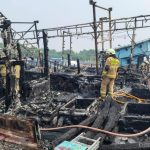




A series of fire incidents, traffic accidents, and workplace accidents that occurred in the past week have once again shaken the public attention and the risk management industry in Indonesia. From the fatal fire at the Terra Drone Building in Jakarta that killed dozens of people, to the blaze at an oil warehouse and electric vehicle facility, to the series of truck accidents and vehicle fires on toll roads—all of these events demonstrate the increasing risk exposure to assets, people, and business operations. The following series of incidents not only caused billions of rupiah in material losses but also exposed serious gaps in safety, technical oversight, and risk mitigation readiness across various business and transportation sectors.
A rental car wash warehouse in Depok was engulfed in flames, destroying four cars, and causing losses of up to Rp1.5 billion.
A fire broke out at a car rental office that also functioned as a car wash and oil shop in the Bojongsari area of Depok City, West Java, early Wednesday (12/17/2025). The incident was reported at around 1:16 a.m. Western Indonesian Time (WIB). The fire first appeared in the rental office and car wash area, then quickly spread to the oil shop next door. As a result of the fire, four parked cars were also burned. Firefighters from Bojongsari, Cinere, and Cipayung deployed four fire trucks and managed to extinguish the fire at around 2:45 a.m. Western Indonesian Time (WIB). Total material losses are estimated at Rp1.5 billion.
Risk & Accident Review
This fire demonstrates the high risk to integrated automotive businesses such as car rentals, car washes, and oil shops that store flammable materials. The combination of electrical installations, lubricants, and motor vehicles increases the potential for fires to grow and spread rapidly. Nighttime operations delay initial fire detection, resulting in significant losses. Key risks include damage to business assets, customer or operational vehicles, business interruption, and potential third-party lawsuits. Prevention should focus on flammable materials management, active fire protection systems, and the separation of high-risk areas.
Types of Insurance Needed
- Property All Risks (PAR) – Protects buildings, car wash equipment, rental offices, and oil shops from the risk of fire.
- Motor Vehicle Insurance (Comprehensive/All Risk) – Covers damage or loss to operational and rental cars.
- Business Interruption Insurance – Covers losses due to the interruption of business operations following a fire.
- Public Liability Insurance – Protection in the event of a claim from a third party (customer, vehicle owner).
Source: https://news.detik.com/berita/d-8263821/car-wash-kebakaran-di-depok-4-mobil-ikut-terbakar
A Toyota Agya caught fire on the Belawan Toll Road in Medan, completely gutted.
A Toyota Agya car with police number BK 1579 ID was burned to the ground on the Belawan–Medan–Tanjung Morawa (Belmera) Toll Road KM 25+00 A, Menteng Village, Medan Denai District, Medan City, on Monday morning (15/12/2025) at around 07.00 WIB. The vehicle was driven by Fernando Sio Argama (45), a resident of West Medan, who was traveling from the Tanjung Mulia Toll Gate to the Medan Amplas Toll Gate. Upon arriving at the scene, the driver smelled oil from under the vehicle and pulled over. When the engine was restarted, a fire suddenly appeared from under the car and quickly grew until it burned the entire body of the vehicle. Although the firefighters were able to handle it, the car burned completely without any casualties.
Risk Accident Review
This incident highlights the risk of vehicle fires caused by fuel or lubrication system leaks triggered by engine heat. Continuing to operate a vehicle despite the smell of oil increases the risk of fire spreading to the engine. Fires on toll roads also increase the risk of further accidents, congestion, and third-party losses. The primary losses result from the total loss of the vehicle and potential evacuation and emergency response costs. Prevention includes routine maintenance, engine system inspections, and stopping the vehicle completely if any signs of serious damage appear.
Types of Insurance Needed
- All Risk Motor Vehicle Insurance (Comprehensive)
Covers total damage due to fire and explosion. - TLO Insurance (Total Loss Only)
Alternative protection if the vehicle’s value has decreased. - Third Party Liability (TPL)
Protects against third party claims resulting from incidents on toll roads. - Driver & Passenger Personal Accident Insurance
Provides compensation in the event of injury or fatal risk. - Roadside Assistance (Add-on)
Assisting with evacuation and emergency handling during incidents on toll roads.
A fire at the Terra Drone building killed 22 people in Jakarta. The explosion is suspected to have originated from a drone battery.
A massive fire engulfed the Terra Drone Building in the Cempaka Putih area of Central Jakarta on Tuesday afternoon (December 9, 2025), killing at least 22 people. The incident occurred suddenly and sparked panic in the building, which was bustling with employee activity. The fire was reported to have started around 12:46 p.m. Western Indonesian Time (WIB), preceded by a loud explosion from the lower floors. Firefighters arrived four minutes later, but the fire quickly spread to the upper floors, producing thick, black smoke that trapped several workers. Some victims were successfully evacuated via the rooftop using emergency stairs, while others were found dead. Initial suspicions suggest an electrical short circuit or a drone battery explosion was the cause of the fire.
Risk Accident Review
This incident demonstrates the high risk of fire in office buildings that store high-energy devices such as drone batteries. An electrical short circuit or failure of the battery storage system has the potential to trigger an explosion and rapidly spread fire, especially if the fire protection system is inadequate. The risk is exacerbated by overcrowding, limited evacuation routes, and toxic fumes that caused fatalities. In addition to the loss of life, this incident resulted in significant asset losses, operational disruptions, and potential lawsuits from the victims’ families. Evaluation of risk management, OHS standards, and fire protection systems is crucial to prevent similar incidents.
Types of Insurance Needed
- Property All Risks Insurance
Covers damage to buildings, facilities and equipment due to fire and explosion. - Business Interruption Insurance
Covering losses due to post-fire operational cessation. - Employers’ Liability / Workers Compensation
Provides compensation for employees who die or are injured while working. - Public Liability Insurance
Protecting from lawsuits by third parties and the victim’s family. - Employee Personal Accident & Life Insurance (Group PA & Group Life)
Provides financial protection for workers and heirs. - Equipment & Electronic Insurance
For the protection of high-risk technological devices such as batteries and drones.
A golf cart warehouse in Bogor was engulfed in flames, destroying nearly 200 electric golf carts.
A fire that engulfed a golf cart storage warehouse in the Kranggan area, Gunung Putri District, Bogor Regency, was successfully extinguished on Wednesday night (12/10/2025). The Gunung Putri Sector Fire Department Commander, Hendra Kurniawan, stated that the fire was brought under control after a more than hour-long extinguishing process and is now entering the cooling phase. The handling took quite a long time due to the size of the building and the large amount of flammable materials inside the warehouse. A total of seven fire trucks were deployed. There were no fatalities because the warehouse was empty. However, nearly 200 electric golf carts that were being charged caught fire, although around 70 units are estimated to have been saved.
Risk Accident Review
This incident highlights the high risk of fire in electric vehicle storage facilities, particularly during mass charging. The concentration of large numbers of lithium batteries increases the potential for overheating, short circuits, and rapid fire spread. The risk is further exacerbated by inadequate fire protection, ventilation, and charging zone separation. While no casualties were reported, the potential for significant loss of valuable assets and operational disruptions could be significant. This incident demonstrates the importance of risk management, technical oversight of electrical installations, and the readiness of fire mitigation systems in electric vehicle storage facilities.
Types of Insurance Needed
- Property All Risks Insurance
Protect warehouse buildings and facilities from fire risks. - Stock & Goods Insurance
Covers damage or loss of stored golf cart units. - Equipment & Electronic Insurance
For protection of batteries, charging systems and electrical devices. - Business Interruption Insurance
Cover potential losses due to operational interruptions. - Public Liability Insurance
Anticipate third party claims if the fire impacts the surrounding environment. - Engineering Risk & Fire Suppression System Coverage
Protecting technical installations as well as fire protection systems.
Oil Storage Warehouse Fire in Solo, Warehouse Contents and Parked Vehicles Burned
An oil storage warehouse in the Solo Baru area of Sukoharjo, Central Java, was hit by a massive fire on Monday afternoon (12/15/2025). The incident began with a loud explosion, followed by large flames and thick black smoke that could be seen from a distance. The fire destroyed the entire warehouse and several vehicles parked in the surrounding area. The Sukoharjo Fire Department deployed four fire engines, assisted by one from the Solo Fire Department. The extinguishing process was difficult due to the flammable and potentially explosive characteristics of oil, so officers used water mixed with detergent to speed up the extinguishing process.
Risk Accident Review
Oil warehouse fires pose a very high risk due to the flammable nature of the material and the potential for multiple explosions. Storing large quantities of oil without adequate temperature control, ventilation, and fire protection systems can accelerate the spread of the fire. Secondary risks include vehicle damage, environmental pollution, and threats to surrounding buildings. The complex extinguishing process also increases the safety risk to personnel. This incident underscores the importance of fire risk management, monitoring the storage of flammable materials, and emergency response readiness in warehouse facilities.
Types of Insurance Needed
- Property All Risks Insurance
Protecting warehouse buildings from the risk of fire and explosion. - Stock & Inventory Insurance
Covers damage or loss of oil supplies. - Motor Vehicle Insurance (Comprehensive)
For vehicles that caught fire in the warehouse area. - Business Interruption Insurance
Covering losses due to the cessation of business operations. - Public & Environmental Liability Insurance
Anticipating third party claims and the impact of environmental pollution. - Fire & Explosion Insurance (Industrial Risk)
Special protection for fire and explosion risks in hazardous materials.
Source: https://www.metrotvnews.com/play/NQAC0p3j-kebakaran-melanda-gudang-oli-di-sukoharjo
Tragedy at OKI Factory! Field Operator Dies While on Duty, Accident Investigation Begins
A factory employee in Ogan Komering Ilir (OKI) Regency, South Sumatra, named Yoga Aditia Pratama, died due to a work accident on Friday morning (12/12/2025) at around 03.00 WIB. The victim was known to be working as a field operator and was monitoring production operations when the incident occurred. Police from the Air Sugihan Police immediately went to the location after receiving the report. The victim was evacuated to the company clinic, but his life could not be saved. The initial suspicion is that the victim fell while on duty, although the exact cause is still under investigation by the company and the K3 team.
Risk Accident Review
Workplace accidents in factory operations demonstrate the high risk of field activities, particularly during night shifts. Fatigue, work environment conditions, lighting, and potential physical hazards such as slippery surfaces or open areas can increase the risk of fatal falls. Despite the implementation of occupational safety and health procedures, these incidents highlight the importance of continuous evaluation of occupational safety systems, worker training, and operational oversight. The risk of workplace accidents not only impacts the victims but also poses legal, reputational, and financial risks to the company.
Types of Insurance Needed
- Workers Compensation / Employer’s Liability Insurance
Covers death benefits and the company’s legal liability to employees. - Work Accident Insurance (BPJS Employment & commercial supplements)
Provide financial protection to the victim’s family. - Personal Accident Insurance (Group PA)
Additional protection for high-risk field employees. - Public Liability Insurance
Anticipate claims from third parties due to operational incidents. - Management Liability Insurance (D&O)
Protection for management from potential lawsuits for negligence in K3 supervision.
A pile-up in Makassar caused by a truck going out of control left one injured and another dead.
A multiple-vehicle accident occurred on Jalan Perintis Kemerdekaan, right in front of the Makassar City Post Office, on Tuesday afternoon (December 16, 2025). A truck traveling from Maros Regency toward Makassar City allegedly lost control and hit several vehicles stopped at a traffic light.
The incident, which occurred around 5:30 PM WITA during heavy traffic, involved an online motorcycle taxi, a Daihatsu Ayla, an Isuzu truck, and a Toyota Avanza. One online motorcycle taxi driver reportedly died from serious injuries as a result of the incident. The truck driver suffered bruises on his legs. Police are still investigating the cause of the accident.
Risk Accident Review
This accident demonstrates the high risk of heavy vehicles operating in urban areas during rush hour. Key factors to consider include potential braking failure, driver fatigue, and traffic congestion at red light intersections. The impact includes not only vehicle damage but also fatalities and the potential for significant third-party claims. Without adequate insurance coverage, the financial risks can be devastating for both the driver and the vehicle owner. This incident underscores the importance of risk management, regular vehicle inspections, and adherence to operational safety standards.
Types of Insurance Needed
- Motor Vehicle Insurance (All Risk/TLO)
Covers vehicle damage due to multiple collisions. - Third Party Liability Insurance (TJH III)
Protects against legal claims for material losses and loss of life to other parties. - Personal Accident Insurance
Provides compensation for death or permanent disability for drivers and passengers. - Employee Insurance / BPJS Employment
It is important for ojol drivers or operational drivers to have work accident protection.
These incidents highlight that the risks of fire, workplace accidents, and transportation accidents are not sporadic, but rather the result of a combination of technical and human factors, as well as suboptimal risk management systems. Recurring patterns such as electrical short circuits, high-energy battery failures, storage of flammable materials, operator fatigue, and weak safety protection demonstrate the need for a more disciplined and integrated risk management approach. In this context, insurance serves as a last resort when prevention fails to stem losses. For business owners, asset owners, and operational managers, regular risk assessments, enhanced safety standards, and the establishment of appropriate insurance programs are no longer optional but urgently needed to maintain business continuity and protect human lives.
—
DON’T WASTE YOUR TIME AND SECURE YOUR FINANCIAL AND BUSINESS WITH THE RIGHT INSURANCE.
HOTLINE L&G 24 JAM: 0811-8507-773(CALL – WHATSAPP – SMS)
Website: lngrisk.co.id
Email: halo@lngrisk.co.id
—