



In many industrial sectors, the presence of insurance brokers has become a common part of risk management practices. The same is true in the shipping industry, including merchant vessel operators, offshore companies, tugboat and barge owners, and logistics companies that manage their own fleets.
However, for some business actors, a fairly basic question still arises:
If insurance companies can now sell policies directly, why do large shipping companies still use brokers?
The answer is not as simple as finding a cheaper premium price.
In international practice, brokers actually act as risk advisors who help companies design asset protection strategies before the risk actually occurs.
The Maritime Industry Has Very Complex Risks
Unlike private vehicles or ordinary assets, ships are productive assets that operate in an environment with a high level of uncertainty.
The risks faced can be:
- ship collision;
- stranded;
- fire;
- bad weather;
- engine failure;
- navigation error;
- to legal liability to third parties.
The losses that arise are not only in the form of ship repair costs, but can also affect operational schedules, charter contracts, company income, and even business reputation.
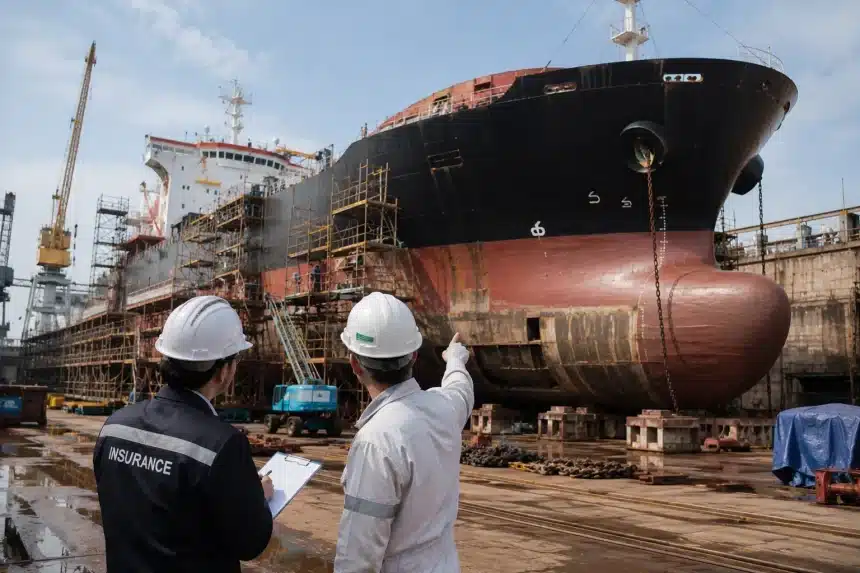
Therefore, the purchase of Marine Hull Insurance generally forms part of a broader risk management strategy.
Brokers and Agents Have Different Functions
One of the misunderstandings that is still often encountered is the assumption that brokers and agents have the same function.
Even though in principle there are fundamental differences.
Agents generally represent insurance companies in marketing their products.
Meanwhile, brokers obtain permission to represent the interests of the insured or prospective insured.
This means that the broker’s job is to help clients find the most suitable protection solution based on the company’s risk characteristics.
This difference is one of the reasons why companies with large assets prefer to use brokers rather than buying policies directly.
It’s Not Just the Premium That’s Assessed
In various maritime industry forums, discussions about Marine Hull Insurance almost always revolve around one important topic, namely the quality of policy wording.
Many practitioners argue that differences in clause content often have a much greater impact than differences in premiums.
Some aspects that are usually of concern include:
- navigational limits;
- deductible;
- additional clauses;
- warranty exclusion;
- claim reporting procedures;
- warranty in the police.
Misunderstanding just one clause can affect the claims settlement process when a loss occurs.
Brokers Help You See Risk Comprehensively
Brokers not only help in getting quotes from several insurance companies.
In practice, they also help evaluate various aspects related to ship operations, such as:
- type of operation;
- shipping area;
- ship value;
- charter contract;
- type of load;
- potential liability to third parties;
- to the company’s ability to bear some of the risks itself.
This approach makes insurance programs more suited to the needs of each company.
When Claims Occur, the Broker’s Role Becomes More Visible
Many companies admit that the benefits of a new broker are truly felt when an incident occurs.
At this stage, brokers usually help coordinate with various parties, from surveyors and insurance companies to preparing the required documents.
The goal is to ensure that the claims settlement process runs more effectively in accordance with policy provisions.
While claim outcomes still depend on the facts of the loss and the applicable policy provisions, good assistance can help reduce administrative obstacles during the process.
Common Practices of Large Companies
In many countries with advanced maritime industries, using an insurance broker is no longer considered an additional cost.
Instead, brokers are seen as part of the company’s risk management system.
This is especially true for companies that operate large fleets or have complex contractual obligations.
By involving a broker from the outset, the company has the opportunity to evaluate the protection structure before the policy is issued.
Choosing a Broker Is Not Enough Based on Company Size
Just like choosing an insurance company, choosing a broker also requires certain considerations.
Some things that are generally of concern include:
- experience in the maritime sector;
- ability to understand shipping contracts;
- quality of claims assistance;
- ability to conduct policy wording reviews;
- network with insurance companies;
- understanding of risk management.
Brokers who understand the characteristics of the maritime industry are usually able to provide more relevant recommendations than just focusing on premium prices.
Conclusion
Marine Hull Insurance is not just a financial product, but is an important instrument in maintaining the sustainability of the shipping business.
Given the complexity of the risks facing the maritime industry, it is not surprising that many large shipping companies choose to use brokers as partners in designing their protection programs.
This approach helps companies view risks more holistically, from the planning stage through to the claims process.
For companies managing high-value assets, the decision about who to oversee the risk management process is often as important as the decision to choose the insurance company itself.
Editor’s Note
LigaAsuransi.com regularly presents various articles regarding Marine Hull Insurance, maritime risk management, and the development of the insurance industry in Indonesia.
For readers who wish to obtain further consultation regarding program preparation ship insurance, policy reviews, and protection needs for shipping companies, one of the national insurance brokers that focuses on maritime sector risks is L&G Insurance Broker.
Further information can be obtained through:
📧 Email us: halo@lngrisk.co.id
📱 Whatsapp: 0811-8507-773