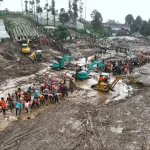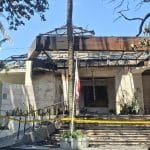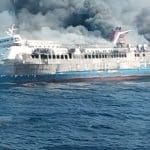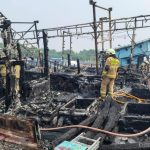




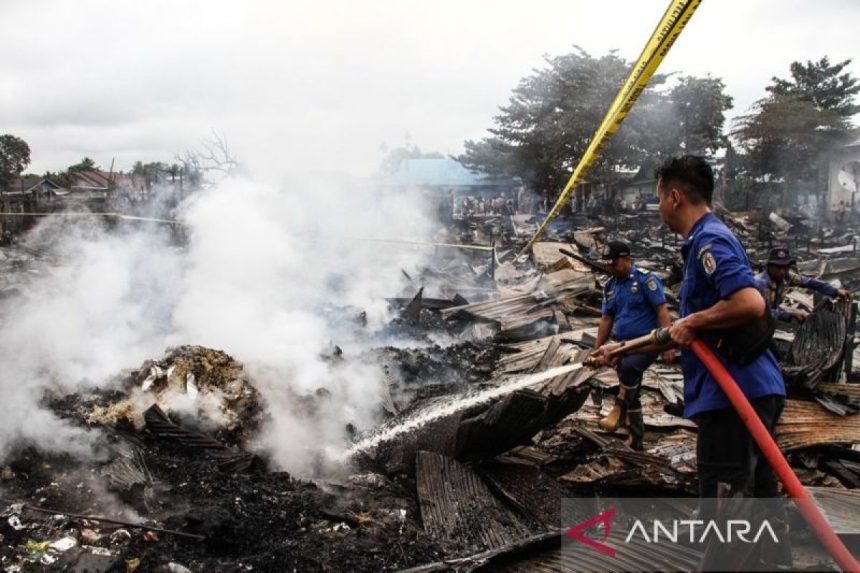
In January 2026, a major fire struck Kasongan Market — the center of economic activity for the people of Katingan Regency.
In a matter of hours:
- Dozens of kiosks burned down
- The trader’s business capital disappeared
- Supply chain disrupted
- The income of hundreds of families has stopped
This incident is not just a local disaster. It is a national warning about the weakness of fire risk management in the traditional trade and MSME sectors.
The question is:
If a similar fire occurs in your business area, is the company financially prepared?
Why Are Traditional Markets So Vulnerable to Fire?
From an industrial risk management perspective, traditional markets have high-risk characteristics:
- Non-Standard Electrical Installation
Overloads, stacked connections, and old wiring are classic triggers for short circuits.
- Flammable Materials
Wood, plastic, textiles, cardboard, cooking oil — accelerate the spread of fire.
- No Fire Compartment
The fire quickly spread from one stall to another.
- Minimal Protection System
- No automatic sprinklers
- No integrated fire alarm
- Limited hydrant
- High Capital Concentration
Dozens of traders store stock in one building block.
In underwriting terms, this is called the High Aggregation Risk Area.
Financial Impact: The Real Loss That Is Rarely Calculated
Many people only saw burning buildings.
But the actual loss is much greater.
Let’s do a simple simulation.
Loss Estimation Simulation (Educational Case Study)
For example, one market block consists of:
- 20 kios
- Building value per kiosk: Rp. 150 million
- Average stock value: Rp. 250 million
Total Exposure Value of One Block:
Building:
20 x 150 million = Rp. 3 billion
Stock:
20 x 250 million = Rp. 5 billion
Total = Rp. 8 billion
Not included:
- Loss of income for 3 months
- Relocation costs
- Damage to public infrastructure
If the average net profit per kiosk is IDR 15 million/month:
20 kiosks x 15 million x 3 months = Rp. 900 million lost profit
👉Total potential economic impact: Rp 8.9 billion
And this is just one small block.
How Should Insurance Work?
For risks such as Kasongan Market, the ideal protection structure includes:
- Property Insurance (Fire & Allied Perils)
Bear:
- Fire
- Explosion
- Lightning
- Asap
- Industrial All Risks (for market managers)
It is suitable if the market is managed by the government or BUMD.
- Business Interruption (BI)
Bear:
- Loss of gross profit
- Fixed costs
- Additional relocation costs
- Public Liability
If the fire causes injury or damage to a third party.
- Collective Insurance Scheme for MSMEs
The most realistic solution for traditional markets is a block-based collective insurance program or trader cooperative.
Insurance Premium Simulation (Educational Estimate)
For example, market fire rates range from 0.15% – 0.30% per year (depending on protection).
If the insurance value of one kiosk:
Building + Stock = Rp. 400 million
With a rate of 0.25%:
Annual premium = 0.25% x 400 million = Rp. 1,000,000 per year
This means: Rp. 83,000 per month.
The cost is less than the price of a carton of mineral water, but it protects hundreds of millions of business capital.
With a collective scheme, premiums can be even more efficient.
Reality on the Ground: Why Are So Many People Uninsured?
Because:
- Lack of risk education
- The assumption that premiums are expensive
- No broker is proactive
- There is no special product design for MSMEs
In fact, the risk of fire in traditional markets is included in the high frequency and high severity categories.
Two Merchants, Two Different Fates
Trader A had no insurance. All stock was lost. It took years to recover.
Merchant B joined a collective insurance scheme. Within a few weeks, he received his claim payment and was able to reopen his stall sooner.
The difference isn’t in luck, but in risk management.
This is the Strategic Role of Insurance Brokers. Many insurance companies simply sell policies. Professional brokers do more than that.
Broker:
✔Conduct a risk survey before the policy
✔Calculating realistic insurance value
✔Designing collective schemes for efficient premiums
✔Avoiding underinsurance
✔Accompanying claims until optimal settlement
Without a broker, traders often face:
- Claim deduction due to average clause
- Rejection due to misdeclaration
- Undocumented stock value
Why is L&G Insurance Broker Worth Choosing?
As a broker with experience in the industrial, construction, and heavy equipment sectors, L&G Insurance Broker understands the risks of aggregation and managing large exposures.
L&G offers:
🔹Risk Assessment Restructure
Identify potential fires and weaknesses in protection systems.
🔹Market Collective Insurance Program
Design solutions for tens to hundreds of merchants.
🔹Accurate Insured Sum Determination
Avoid fatal underinsurance.
🔹 Business Interruption Modeling
Protecting not only assets, but profits.
🔹 Claim Advocacy
Monitor the claims process for optimal and fast payments.
🔹MSME Risk Education
Helping traders understand the importance of business protection.
L&G’s approach is not simply protection, but a strategy for local economic sustainability.
National Perspective: Why Does It Matter?
Indonesia has thousands of traditional markets.
If just 10% of the country experiences fire every year, the impact on the micro economy is enormous.
Market collective insurance can be:
- Regional economic stability instruments
- Post-disaster poverty mitigation tools
- Part of the regional financial strategy
Big Lessons from Kasongan Market 2026
- The risk of a market fire is very real.
- The biggest loss is the loss of cash flow.
- The premium is relatively small compared to the exposure value.
- Collective schemes are a realistic solution.
- A professional broker is the key to effective protection.
Don’t Wait for the Next Fire
The Kasongan Market fire is a stark warning.
Risk of never giving prior notification.
But protection can be prepared from now on.
If you are:
- Market manager
- Local government
- Traders’ cooperative
- Business owners with kiosk concentration
- Commercial property investors
Now is a good time to evaluate your risk protection.
L&G Insurance Broker is ready to help design affordable, strategic and sustainable insurance solutions.
Because ultimately: Fire may be unpredictable. But its impact can be managed.
—
DON’T WASTE YOUR TIME AND SECURE YOUR FINANCES AND BUSINESS WITH THE RIGHT INSURANCE.
HOTLINE L&G 24 JAM: 0811-8507-773 (PHONE – WHATSAPP – SMS)
Website: lngrisk.co.id
Email: halo@lngrisk.co.id
—