



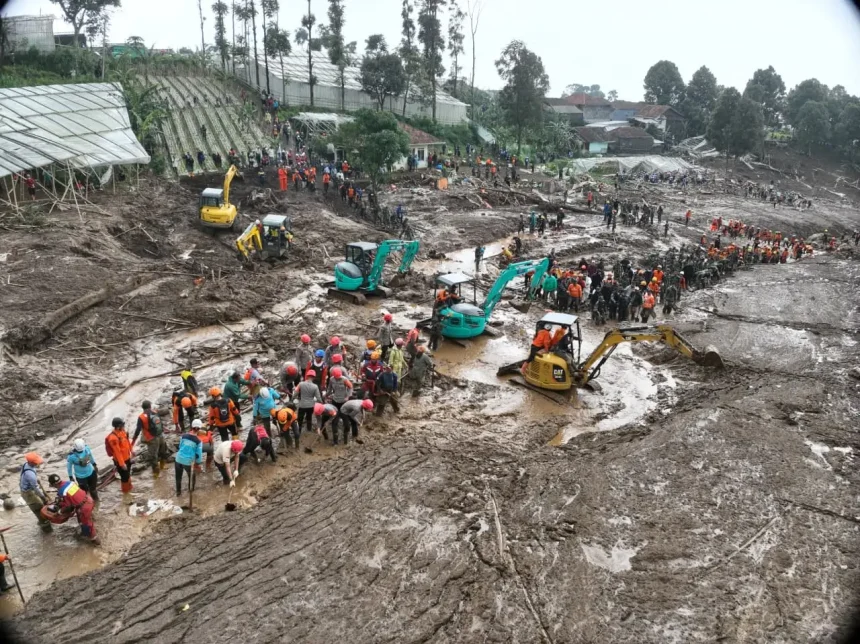
On January 24, 2026, a massive landslide struck Pasirlangu Village, Cisarua District, in West Bandung, killing hundreds of people and burying dozens of homes in mud and rocks. This incident was not only a humanitarian tragedy but also a strong signal to property owners, developers, local governments, and the insurance industry that traditional risk financing models are often insufficiently rapid and targeted to aid recovery. Initial reports and evacuations highlight the urgent need for faster, more transparent, and more scalable disaster financing mechanisms—one of which is through parametric insurance and appropriate disaster risk financing schemes.
Brief chronology & DPS exposure
The landslide occurred early in the morning after prolonged heavy rain; the sudden mudflow blocked the upstream river channel and mobilized slope material, dragging houses along the banks. Evacuation and the search for victims were complicated by the terrain and subsequent rainfall. As of initial reports, dozens of houses were severely damaged and hundreds of residents were displaced; deaths and missing persons were reported in a range of numbers that were continuously updated by local authorities. The incident revealed two main types of exposure: (1) physical property losses (houses, micro-infrastructure) and (2) non-physical economic losses (lost income, relocation costs, impacts on tourism/local MSMEs).
Why traditional disaster financing schemes are less than optimal
Post-disaster response often relies on emergency regional budget allocations, donations, and humanitarian assistance. Key constraints:
- Disbursement time — The administrative and verification process is slow; families need fast cash assistance.
- Budget uncertainty — Local budgets are limited; the scale of events can exceed local fiscal capacity.
- Moral hazard & misallocation — Ad hoc needs-based aid can be disproportionate.
- Lack of exposure data — Without measurable geospatial data and weather indices, it is difficult to determine funding and mitigation priorities.
This requires a pre-arranged finance approach—instruments that are ready and measurable before a disaster strikes: parametric insurance, contingent credit, catastrophe bonds, and inter-regional risk pooling. This approach accelerates liquidity during an event and reduces the long-term fiscal burden.
What is Parametric Insurance and why is it relevant?
Parametric insurance pays claims based on measurable triggers (parameters) — for example, rainfall > X mm in 24 hours, slope acceleration, or a river flow index exceeding a threshold — rather than waiting for individual physical damage estimates. Its advantages:
- Fast payouts (hours–days) because claims are triggered automatically based on sensor/weather station data.
- Transparency — payout rules are clear and can be published.
- Low administration fees — no initial physical survey required to trigger payment.
- Suitable for large-scale risks such as flash floods and river-sourced landslides (mudflow) triggered by extreme rainfall.
Limitations: Not all damage will be covered (based on loss estimate vs. actual loss), so parametrics are most effective when combined with other instruments (top-up indemnity insurance or social cash assistance). In the case of West Bandung, hydrometeorological modeling and upstream river flow studies can form a reliable index to trigger parametric claims.
Design of a disaster risk financing scheme for landslide-prone areas
A practical scheme for districts/cities or district consortiums of tourism in the highlands:
- Risk Assessment & Mapping — Combine geomorphological data, historical rainfall, and asset inventory (houses, roads, tourist attractions).
- Parametric Layer (Fast) — A parametric contract that triggers an automatic payout when the rainfall/stream flow index exceeds a threshold corresponding to a mudflow scenario. The payout is used for emergency assistance (evacuation, shelter, cash transfers).
- Indemnity Layer (Top-up) — Conventional policy for major property damage (home rehabilitation, vital infrastructure).
- Contingent Credit — Ready-to-use credit facilities from banks/IFIs for medium-term infrastructure recovery.
- Community Micro-Insurance — Affordable premium scheme for vulnerable households, co-subsidized by the government.
- Risk Pooling — Two or more districts form a pool to reduce premiums and increase claims capacity.
This scheme prioritizes rapid (parametric) liquidity for initial living expenses, then uses indemnity and credit for major repairs. Case studies and pilots are essential in vulnerable areas to refine the threshold and payout.
The Strategic Role of Brokers: Connecting Technology, Markets, and Communities (≈200 words)
Experienced brokers do more than simply place policies. They act as a bridge between local governments, international underwriters, donor agencies, and local communities. A broker’s role includes:
- Design & Structuring: Helps design a combination of parametric + indemnity that suits the location exposure.
- Access to Market: Connecting local governments/communities to international reinsurance markets that provide competitive capacity and pricing.
- Data & Modeling Coordination: Coordinating trigger data (rainfall, streamflow) with data providers/climate models.
- Capacity Building: Training BPBD, sub-district heads, and local cooperatives to manage parametric claims and aid distribution.
- Claim Advocacy: Acting as a liaison when a trigger occurs, ensuring fast payouts and proper use of funds.
As an example of effective practice, L&G Insurance Broker can offer end-to-end services: local risk assessment, parametric product design, placement into local & global markets, as well as claims assistance and communication with donors — so that local governments and property developers can minimize recovery time and mitigate socio-economic impacts.
Practical Recommendations for Local Governments & Property Owners
- Conduct hazard mapping and registration of critical assets.
- Implement early warning systems (AWAS + rainfall/streamflow sensors).
- Parametric pilot testing in vulnerable villages for threshold calibration.
- Provide premium subsidies for poor groups to increase protection coverage.
- Integrate insurance with spatial planning — do not allow development on river channels/damaged slopes without mitigation.
- Develop green mitigation programs (upstream revegetation) as a condition for premium reduction.
Quick FAQ (3 questions)
Q: Does parametric insurance replace conventional insurance?
A: No. Parametrics are most effective as a rapid liquidity layer; they need to be combined with indemnity and fiscal mechanisms.
Q: How fast is the parametric payout?
A: It can take a few hours to a few days after the trigger is verified.
Q: Who is suitable to be a parametric buyer?
A: Local governments, tourism associations, housing developers in vulnerable areas, and farmer/MSME cooperatives.
Cover
The 2026 West Bandung landslide highlighted the importance of rapid response as long-term mitigation. Smart disaster financing schemes—combining parametric insurance, indemnity, contingent finance, and community programs—accelerate recovery and reduce fiscal burdens. If you represent a local government, property developer, or community looking to design a parametric pilot or assess your project’s exposure, L&G Insurance Broker’s team of experts is ready to assist: from risk mapping to global reinsurance market placement and claims assistance. Contact us for a practical, cost-effective, and fast-implementation scheme design consultation.
—
DON’T WASTE YOUR TIME AND SECURE YOUR FINANCES AND BUSINESS WITH THE RIGHT INSURANCE.
HOTLINE L&G 24 JAM: 0811-8507-773 (PHONE – WHATSAPP – SMS)
Website: lngrisk.co.id
Email: halo@lngrisk.co.id
—